
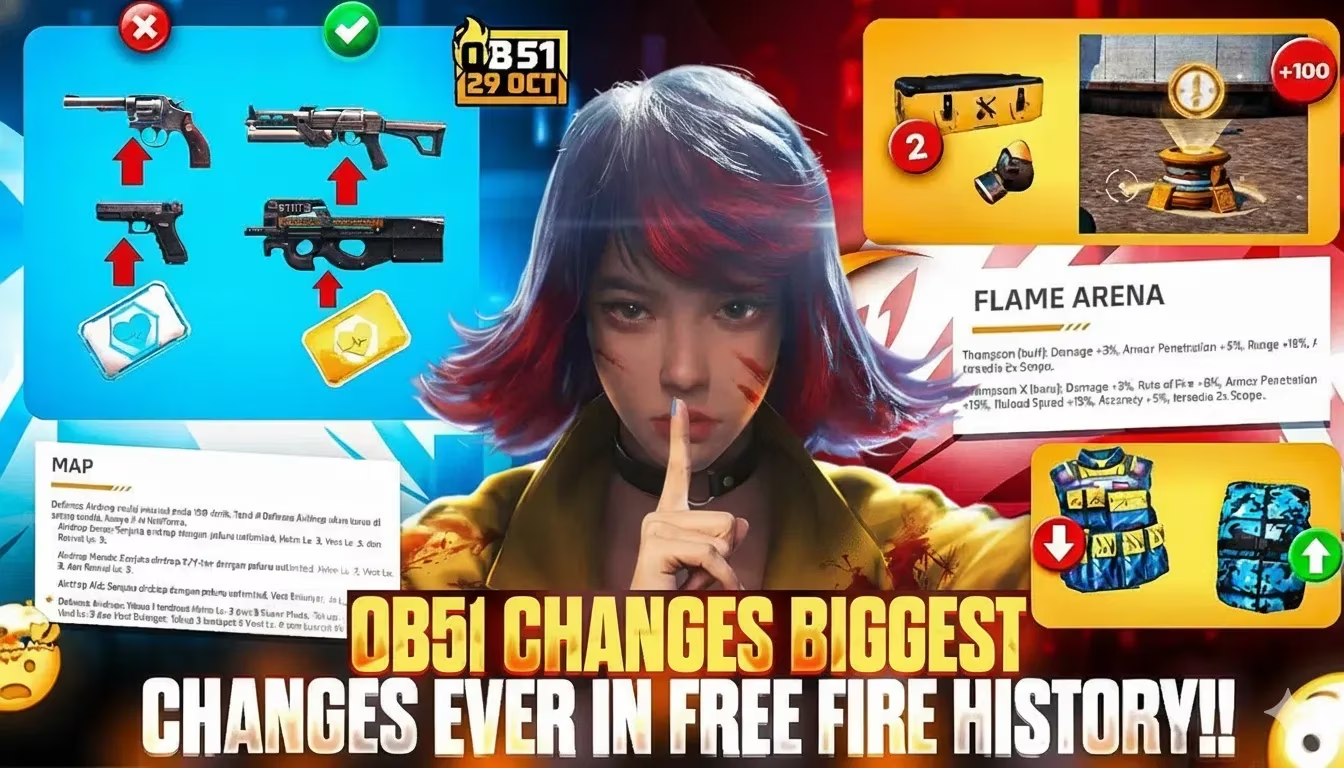
It was the final weekend of October 2025 when the servers went dark. Leo, a seasoned Free Fire esports contender accustomed to clutching victories with an MP40 and a dream, sat in his dimly lit gaming room staring at the countdown on the login screen. The words OB51 had been circulating in every Discord server and chat group for weeks. Rumors spilled out: Thompson would finally get a scope, knockdown times were being butchered, and a new weapon variant called Thompson X would arrive without mercy. He had not believed half of it until the patch notes hit his phone like a hurricane of green metadata. This was not a routine balance patch. This was a full-scale upheaval of the entire Battle Royale fabric.
When the game came back online, Leo dropped into Bermuda with a random squad, his mind struggling to process the early whispers of the new knockdown system. Immediately, he understood the psychological shift. A teammate got knocked by a mid-range SCAR burst near the Observatory, and the kill feed showed a health drain speed he had never witnessed. Instead of the leisurely 35-second crawl that had allowed dozens of comebacks, the downed player's HP evaporated in just 14 seconds. It forced Leo’s squad to react with frantic urgency, throwing Gloo Walls and crashing through windows to attempt a rescue. The game was no longer forgiving toward passive bleed-outs. The meta was now screaming: commit or abandon, there is no third option.
However, the patch notes had also carved a clever exception. In close-quarter brawls – when a knockdown came from weapons like the MP40 or a shotgun blast within 15 meters – the timer remained a generous 35 seconds. This meant building-to-building fights retained their chaotic, sweaty drama, but getting picked off by a sniper from the hills meant you were almost certainly doomed. Another sly addition made those final seconds slightly more hopeful: crawling speed jumped by 35%. Leo saw a downed enemy slither behind a crate at a pace that forced him to flick harder than ever before.
What truly rewrote the gunplay narrative, however, was the armory overhaul revolving around the Thompson. For years it had been the underrated workhorse – reliable but never flashy. Now, a 2x scope sat snugly on its rail, a privilege previously reserved for the BZ and P90. That simple optical addition transformed the weapon from a hip-fire brawler into a versatile mid-range beam machine. Leo picked up a stock Thompson near Mars Electric and immediately aimed down sights. The clarity was crisper. The damage, increased by 3%, paired with 5% more armor penetration and 10% longer range, meant he could contest UMP users at distances where they once laughed at his tickle damage. The 5% accuracy buff tightened the spread, making headshots more consistent even without skins. The SMG hierarchy had shifted overnight.
And then there was the spectral shape lurking in the airdrops: the Thompson X. This exclusive variant turned the already fortified Thompson into a mythological beast. Besides carrying the standard upgrades, the X version boasted an additional 8% fire rate, a staggering 10% upgrade to armor penetration, 15% more range, and a 15% faster reload. Leo acquired his first Thompson X during a CS Rank match after his team secured a red crate near the bridge at Mars Electric. The gun chewed through a Level 3 vest as if it were cardboard. He could feel the meta dissolving around him – players who would have once clung to the MP34 or P90 were now scrambling to learn the recoil pattern of this refurbished classic. The in-game economy mirrored the shift: the Thompson’s price in the Credit Score Rank vending machine climbed, signaling its new elite status. The upgrade chips that could be bought only twice added a strategic layer, forcing teams to carefully allocate resources. Those who spent their purchase limit foolishly were left holding under-leveled gear when the final circles collapsed.
Leo’s landing routine also underwent a radical transformation. Before OB51, everyone dropped with the standard G18 and the P9 pistol – a setup so stale that seasoned players had memed about it for seasons. Now, the devs had gifted every survivor a M970 pistol and a Bajan, instantly making the initial scrappy fights more dangerous and mechanically demanding. The M970’s burst potential deleted unarmored opponents far quicker than the old peashooters, while the Bajan’s respectable mid-range performance made early rotations a legitimate threat. Alongside this weapon swap came a fundamental change to survival inventory. Leo found himself landing with four Med Kits and two Gloo Walls instead of the previous paltry two meds. Even more bewildering, Med Kits no longer consumed backpack space. The rule change felt telepathic; the developers had finally acknowledged that carrying heals should never punish a player for attempting to stockpile utility items. Bonus synergies appeared everywhere: grabbing 200 FF Coins from a coin machine now rewarded him with two additional Med Kits, turning economic safe spots into mini healing stations.
The vending machine economy received its own set of shockwaves. Level 3 Backpacks dropped from 300 FF Coins to a more reasonable 200, easing the burden on support players. However, Level 3 Helmets could now be purchased only a maximum of five times across the entire map, injecting scarcity into the late-game durability race. The free attachment handouts that once cluttered the kiosk disappeared entirely, meaning scopes, muzzles, and stocks had to be looted with genuine effort. Perhaps the most jarring removal was the disappearance of Level 4 vests and airdrop weapons from map spawns. No longer could a squad stumble upon pre-ordained god armor simply by luck. The playing field had been forcibly leveled, rewarding those who mastered positioning and aim over lottery-based gear accumulation. The infamous Winchester 2 and the M62 D Chip joined the store at a crisp 300 FF Coins each, sleek alternatives that demanded tough spending decisions.
A completely reimagined revival mechanic turned Leo’s outlook on risk-taking upside down. In the old era, dying meant your coins vanished into the void; resurrecting brought you back naked into the final zones, a walking target. After OB51, upon revival, a player received exactly 50% of their coins back. Leo tested this during a nail-biting match on Alpine. He had saved 1,000 FF Coins, bought a Level 3 vest, and then recklessly pushed a triple squad near the Catfish processing plant, dying in a glorious blaze. Upon revival, 500 coins blinked into his inventory. That was enough to snag a Repair Kit and an Inhaler combo (now a two-use bundle instead of a single charge) and rejoin the fight with a fighting chance. The game no longer punished aggression with total poverty; it offered a lifeline that kept teams in competitive rhythm. Coupled with the squad’s ability to manage infinite Med Kits without backpack anxiety, the heal meta thickened into a vital part of macro strategy. Squads began rotating with designated heal carriers, knowing they could tank zone damage longer than ever before.
The cumulative result of nearly 30 to 40 gameplay adjustments was a Battle Royale that felt awake again. The Arsenal system, now upgradable from outside, allowed teams to strategically funnel resources into transforming their weapon pool. For a price, they could replace existing Level 3 weapons like the MP5 with more potent choices, though the Level 3 M10 and M4A1 were deliberately pulled from the map to prevent a single rifle from dominating every engagement. The Ignis and Kenta character skills started appearing more frequently, their utility now synergizing with the faster pace and shorter knock timers to create combos that pro analysts would study for months.
By the time Leo queued into his third CS Rank match of the day, clutching his Thompson X with a 2x scope glowing in the afternoon sun, he realized the OB51 update had not merely tweaked numbers. It had fundamentally transformed player psychology. No longer could anyone lazily crawl for 35 seconds waiting for a miracle. No more could they hoard useless pistols, ignore the potential of a Thompson, or treat revivals as cosmetic cutscenes. The new Free Fire demanded adaptability, speed, and a willingness to abandon old comfort zones. Esports teams began restructuring their drop strategies around the M970/Bajan start, assigning designated coin farmers who would rush to vending machines knowing every 200 coins batch gifted meds. Coaches practiced crouch-walking drills with the faster crawling speed to maximize cover reach before the 14-second window closed. The game had evolved, and those who adapted with it would write the next chapter of its competitive legacy.
As Leo’s name flickered on the winner’s screen after a 12-kill victory, the lobby filled with chat emojis. He smiled, scrolling through the in-game patch notes once more. The OB51 update was not a seasonal decoration; it was a redefinition. The Thompson had become a kingmaker, the knockout clock a ruthless teacher, and the half-coin revive a symbol of second chances. In the ever-shifting world of Free Fire, October 2025 would be remembered as the month the rulebook was set on fire – and the players were handed the matches to ignite something new.