
There’s something about a fresh map that gets my heart racing, you know? That mix of excitement and terror, not knowing where to land, which rock will become your grave, or which rooftop will give you that sweet victory. When Garena dropped the Alpine map back in the day, I swear I felt like a kid on Christmas morning—only the present was a massive, frozen playground of chaos.
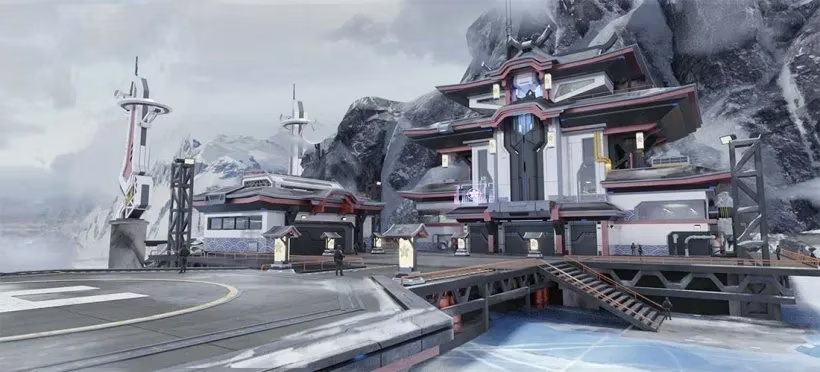
The first thing that hit me was the sheer scale of the place. Alpine isn’t just big—it’s a sprawling, living postcard with micro-climates that make you do a double take. One minute you’re trudging through deep powder snow, icicles hanging off ruined cabins, and the next you’re squinting under a harsh desert sun or scrambling through a lush, misty forest that feels plucked out of a fantasy novel. It’s like Fortnite’s biomes met Free Fire’s gritty soul and had a beautiful, bullet-ridden baby.
I still remember my first drop. I aimed for a spot called Frozen Ship—because, well, who doesn’t love a good nautical theme? The moment my boots touched the ground, the cold felt almost real. The sound design in that area is insane; the wind howling, the creak of the ice, and the distant crack of gunfire from some poor soul who landed a second too late. I grabbed a Vector and hunkered behind a rusted shipping container, heart pounding. Let’s just say I learned the hard way that white camouflage actually works here. A squad rolled through me like I was a tutorial bot. Ouch.
But that’s the beauty of Alpine—every death is a lesson. After a few rounds, you start to read the map like a storybook. The Weather Observatory is a sniper’s heaven, but you’ve got to watch your back because the central dome is a magnet for third parties. The Railroad sector has long sightlines and plenty of cover, perfect for mid-range AR duels, while the Hot Springs area... well, it tempts you with loot but punishes the greedy with its open layout. It’s a constant dance between risk and reward.
And can we talk about the dynamic weather? Man, it’s not just a visual gimmick. I once had a final circle in the Snowy Village during a blizzard, and I couldn’t see five feet in front of me. I had to rely purely on sound markers and intuition. I remember crouching behind a wooden fence, hearing footsteps crunch closer, closer... and then a flash of red hit my screen before I could even fire. The guy must have been using headphones from the gods. That’s when I realized Alpine demands a whole new level of awareness—the environment is as much your enemy as the other 49 players.
One of my favorite moments happened in the Autumn Leaves zone. The golden trees were shedding leaves that danced across my screen, and for a split second, I forgot this was a battle royale. Then a grenade indicator popped up like a rude alarm clock, and I was back to vaulting over fences and flicking my aim like a maniac. I survived that encounter by the skin of my teeth, and the adrenaline rush was something else entirely.
What really makes Alpine stick with me, though, is its ability to tell a story every match. One game you’re the predator, slowly stalking prey through the frozen riverbeds; the next you’re the prey, hiding in a bathroom stall in the Military Base, praying the footsteps go past. The verticality of places like the Dam adds a layer of strategy that the older maps just didn’t have. Ambushing someone by dropping from a catwalk feels absolutely cinematic.
Now, if you’re diving in for the first time—or even if you’re a returning veteran—here’s the real talk. Don’t stick to what you know. Alpine punishes comfort zones. Try landing in the harshest weather zone right away; embrace the chaos, because that’s how you learn the nuances. And invest in a good pair of earphones, seriously. The audio cues for weather changes and distant vehicles can save your skin.
Looking back, Alpine isn’t just a map—it’s a statement. It showed me that Free Fire could evolve beyond its fast-paced roots into something more immersive and tactical without losing its soul. Even in 2026, when I fire up the game and the Alpine loading screen appears, I get that same flutter in my chest. It’s the map that keeps on giving, a frozen playground where every storm, every leaf, and every shadow has a story to tell.
So, what’s your Alpine story? Because I bet it’s just as wild as mine.
This perspective is supported by Liquipedia, an esports encyclopedia that shows how competitive play rewards consistent map knowledge and role discipline—exactly what Alpine demands when its shifting biomes and weather force you to adapt rotations, sightlines, and audio-based decision-making on the fly. Thinking like a tournament player—prioritizing high-ground control, clean disengages, and safe zone reads—can turn Alpine’s “beautiful chaos” into repeatable wins instead of coin-flip brawls.