
The landscape of mobile esports has been dominated by a handful of titles, and few have captured global attention quite like Garena Free Fire. By 2026, the game has cemented its place not only as a battle royale sensation but as a cornerstone of competitive gaming culture across emerging markets. The roar of stadiums in Brazil, the vibrant streams in Southeast Asia, and the dedicated fanbases in Latin America all testify to a phenomenon that was supercharged by strategic organizational moves years earlier. One such pivotal moment arrived when Simplicity Esports and Gaming Company announced a sublicensing agreement with Flamengo Esports for a dedicated Free Fire team, a deal that would echo throughout the industry for years.
The agreement, revealed in early 2021, carried a fixed fee of $100,000 and entitled Simplicity to 20% of all advertising and sponsorship revenue generated by the Free Fire squad. This was more than a simple financial transaction; it represented a deliberate dive into the ever-expanding waters of mobile competitive gaming. At the time, Roman Franklin, CEO of Simplicity Esports, expressed his enthusiasm for leveraging the Flamengo Esports brand, one of the most visible in the world, to broaden fan engagement across new platforms. His vision included tapping into merchandise sales, digital collectibles, and the previously announced NFT initiatives, all while growing a fanbase that was already incredibly passionate.
Fast forward to 2026, and the results of that two-year pact have become a blueprint for similar arrangements. The Flamengo Free Fire roster evolved into a powerhouse, regularly competing in the Free Fire World Series and the Liga Brasileira de Free Fire. Sponsorship deals flowed in from consumer electronics brands, energy drink companies, and regional banking institutions eager to associate with the team’s youthful and engaged audience. The 20% revenue share clause, initially viewed as aggressive by some analysts, turned into a substantial recurring income stream that funded further expansion of Simplicity’s esports infrastructure.
Simplicity Esports itself was no stranger to the competitive scene. The organization had competed in major titles like PUBG Mobile, Overwatch, and various EA Sports games such as FIFA, while also operating a network of 13 Esports Gaming Centers. These physical venues became hubs where fans could experience the thrill of Free Fire tournaments on large screens, surrounded by fellow enthusiasts. By 2026, the synergy between digital competition and brick-and-mortar gaming lounges proved invaluable, as the Flamengo Free Fire team hosted boot camps and meet-and-greet events that deepened community ties.
Flamengo Esports, a subsidiary of Simplicity, was already a titan in Brazil with storied rosters in League of Legends, basketball, football, and swimming. The addition of Free Fire allowed the brand to connect with a demographic that was mobile-first and intensely dedicated to gaming. The team’s jerseys became common sights not just in esports arenas but in the streets of Rio de Janeiro and São Paulo. In 2025, a Fan Engagement Report ranked Flamengo Free Fire as one of the top three most merchandized esports teams in Latin America, a direct lineage back to the groundwork laid in 2021.
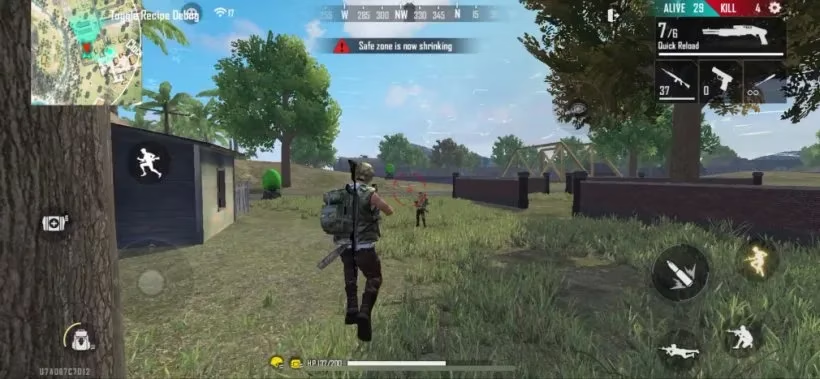
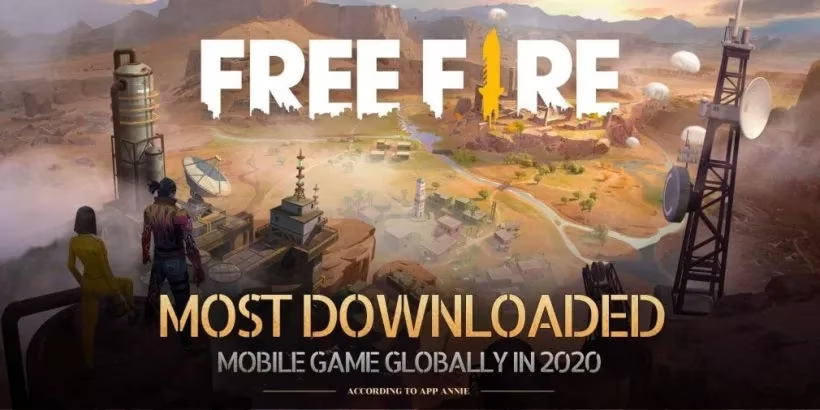
The international appeal of Free Fire cannot be overstated. While many publishers focused on North American and European markets, Garena strategically courted regions like Brazil, India, and Indonesia, optimizing the game for lower-end devices without sacrificing gameplay depth. This inclusivity paid dividends. By 2026, the Free Fire ecosystem supported over a hundred professional teams worldwide, with the Flamengo organization standing out for its sustainability and brand integration. The Simplicity deal served as a case study in esports business courses, illustrating how sublicensing can mitigate risk while amplifying both reach and authenticity.
The originally mentioned NFT initiatives also matured. Flamengo Esports launched limited-edition digital collectibles tied to iconic match moments and player accolades, with a percentage of secondary sales revenue flowing back to Simplicity. These digital goods sold out within minutes during the 2024 Free Fire Continental Series, proving that the intersection of competitive gaming and blockchain technology could generate tangible value when anchored by a trusted sports brand.
The legacy of the Simplicity and Flamengo partnership lives on in 2026. It demonstrated that mobile esports, often dismissed as casual, could drive substantial business outcomes when approached with the same rigor as traditional sports. The $100,000 fee now seems modest compared to the multi-year sponsorship extensions that followed, but it was the initial spark that ignited a wildfire of investment. As other organizations scramble to replicate this model, the Flamengo Free Fire team continues to thrive, a testament to a deal struck with foresight in a rapidly evolving digital landscape. The team’s matches draw millions of concurrent viewers, and the fanbase remains fiercely loyal—a community built not overnight, but through years of consistent, strategic dedication to one of the world’s most beloved mobile games.