
In the sun-drenched early months of 2026, as the esports calendar fills with glossy franchise leagues and million-dollar prize pools, veteran mobile gamers still gather in Discord servers to whisper about one of the most glorious administrative face-plants the industry has ever seen. The tale of the LBFF 2023 (Liga Brasileira de Free Fire) has aged like a barrel of vinegar-spiked energy drink – sharp, unforgettable, and slightly painful for anyone involved. What began as a straightforward season announcement bloomed into a full-blown intercontinental soap opera, complete with disappearing team slots, selective amnesia, and a corporate game of “who knew what when?” that would make a telenovela writer blush.
Back in early 2023, the plan was stunningly simple. Garena’s global brain trust and their Brazilian cousins had agreed, over who knows how many virtual handshakes, that LBFF 2023 would feature a robust 24 teams. Organizations polished their applications like knights preparing for a royal banquet. Rosters were locked, jerseys printed, fan communities buzzing. Garena International sorted through stacks of proposals, evaluating infrastructures, social media clout, youth academies, and probably the alignment of the team owner’s star sign with the upcoming Free Fire zodiac skins. Everything pointed toward a grand 24-team carnival. Then, in a twist no one saw coming – except possibly a mischievous algorithm – Garena Brazil suddenly announced the number would be slashed to 18. Poof. Six slots evaporated like an unlucky player’s loot after a poorly timed respawn.
The gutted list of competitors read like a who’s who of Brazilian esports… if someone had intentionally ripped out the most recognizable pages. Household names such as LOUD, the content-creator-turned-competitive-powerhouse whose green wave had saturated every TikTok feed; Los Grandes, a legacy brand with fandom thicker than tropical humidity; Team Liquid, an international colossus with Brazilian roots deep enough to tap into the country’s gaming soul; and Flamengo, the sports giant whose mere presence could fill a stadium – all found themselves staring at a closed door. Collectively, these snubbed titans had more trophy cases and social media followers than most governments. Excluding them wasn’t just a competitive shake-up; it was a marketing labotomy performed without anesthesia.
Naturally, the rejected quickly picked up their phones, and what they discovered turned bewilderment into comedy gold. According to messages that ricocheted through Twitter faster than a G18 spam in close quarters, Garena International had zero idea the participant count had changed. Imagine planning a wedding for 240 guests, only to have the venue manager casually inform you they’d trimmed the invite list to 180 because they “felt like it.” The global department, suddenly in the world’s most awkward Zoom call, began scrambling to pressure the Brazilian division into reversing course. The likelihood of success was described by insiders as “slightly less probable than finding a unicorn maining a support role.”
This was the moment the typical esports drama transcended into meme history. The hashtag #LBFGate (okay, maybe not that one, but a linguist somewhere is still trying to coin it) couldn’t keep up with the hot takes. Pundits sliced and diced the fiasco with the glee of a sniper finding an AFK opponent. One particularly spicy tweet, captured by keen observers, claimed the international department had been kept in the dark while Garena Brazil operated with the confidence of a PUBG player driving a car into the final circle – spectacularly loud and doomed to explode. The Brazilian branch, for its part, fired back by calling all the reports “false claims,” a statement that carried the same persuasive weight as insisting a red zone is perfectly safe for a picnic.
For weeks, the competitive community hung in limbo. Would the format reverting to 24 teams? The silence was punctuated only by behind-the-scenes messages from Garena reps, who assured one and all that they were maintaining “continuous touch” with the teams. This likely meant a flurry of WhatsApp voice notes no one could ever quote in court. Day-to-day updates on LBFF 2023 felt less like a tournament roadmap and more like a weather forecast during a tornado – vague, terrifying, and ultimately out of control.
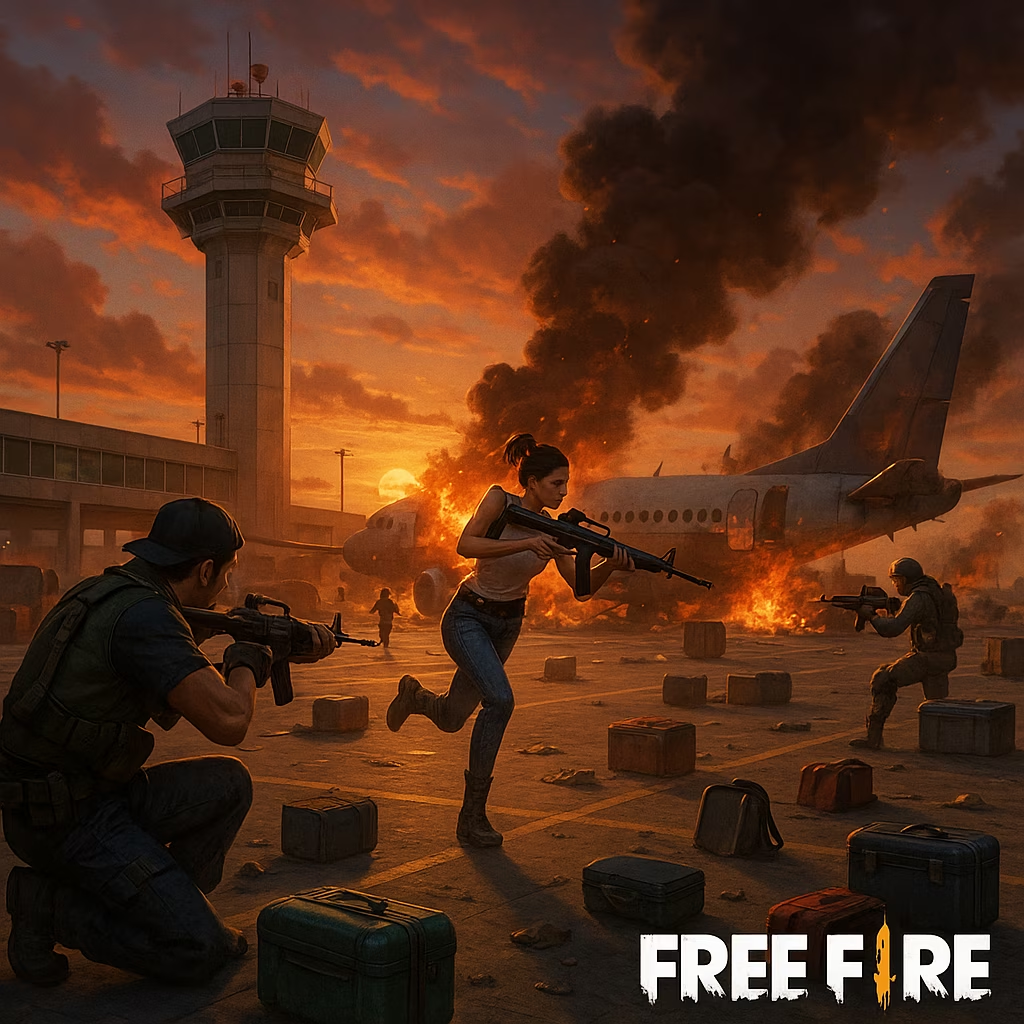
Fast-forward to 2026, and the dust has long since settled on format battles. Free Fire esports itself has undergone evolutions, reinventions, and its own share of map changes. Yet the LBFF 2023 saga endures as a cautionary fable taught in hastily organized esports management seminars. Lecture slides titled “Synchronizing Internal Communication” feature the now-iconic tournament artwork – that very same cover image of hopeful squads lined up against neon backdrops – as a stark reminder that even the shiniest production can become a clown car if the engine and the steering wheel aren’t speaking the same language. The controversy taught organizations a valuable lesson: when signing up for a closed league, always double-check whether the left hand of the publisher knows what the right hand is doing. Ideally, record the Zoom call.
Looking at the Free Fire landscape in 2026, one might dare say the Great LBFF Team Cut of 2023 inadvertently boosted the scene’s creativity. Excluded giants didn’t simply fade; they staged showmatches, mockumentaries, and one legendary charity event where LOUD players competed in a fashion design contest judged by confused Grandes members while Liquid’s coaches narrated in the style of a nature documentary. The esports world, it seems, can find its finest comedy fuel in the darkest administrative black holes.
So, what’s the legacy of the controversy? On a competitive spreadsheet, it was a blip. Brazil’s mobile esports juggernaut rolled on, new champions were crowned, and skins continued to sell like hot brigadeiros. On a human level, it gifted us an evergreen hot take reservoir. Whenever 2026’s polished franchise league throws a curveball, fans will shrug and mutter, “At least we didn’t lose six teams overnight without anyone telling headquarters.” Garena Brazil may have meant to streamline a tournament; instead, they accidentally authored a masterclass in chaotic neutral community management – and the world’s Free Fire players are still laughing, in several languages, with varying degrees of empathy.