
In the summer of 2021, a palpable hum of excitement swept across the mobile gaming community. Garena, the powerhouse behind the wildly popular battle royale Free Fire, had finally lifted the curtain on something extraordinary. It was called Free Fire MAX, and it promised to deliver the same frantic, high-stakes survival action wrapped in a coat of glossy, next-generation polish. For millions of players who had been dropping onto Bermuda and Kalahari for years, this was the upgrade they never knew they desperately needed.
Pre-registrations opened that very day on the Google Play Store, and the response was nothing short of explosive. From Lagos to Lima, from Mumbai to Manila, fans queued up virtually to secure their spot. It wasn’t just a new download; it was a symbol. A standalone application, Free Fire MAX was engineered to be a spec-heavy titan, leveraging advanced effects, fluid animations, and dramatically enhanced graphics that could push even flagship devices to their limits. Yet, Garena revealed a brilliant masterstroke that eased every veteran’s mind: the two worlds would collide.
Players on the original Free Fire and those on the shiny new Free Fire MAX would be able to play together seamlessly. The same friends, the same lobbies, the same chaotic final circles. But here’s where the magic deepened — account data, progress, skins, weapon upgrades, and every hard-earned cosmetic synced perfectly between both applications. A player could grind ranked matches on Free Fire during their morning commute on an older device, then switch to Free Fire MAX at home on their tablet to bask in the visual glory of a sunset-lit factory zone, all without losing a single achievement. 🔄 The developers had built a bridge, not a wall.
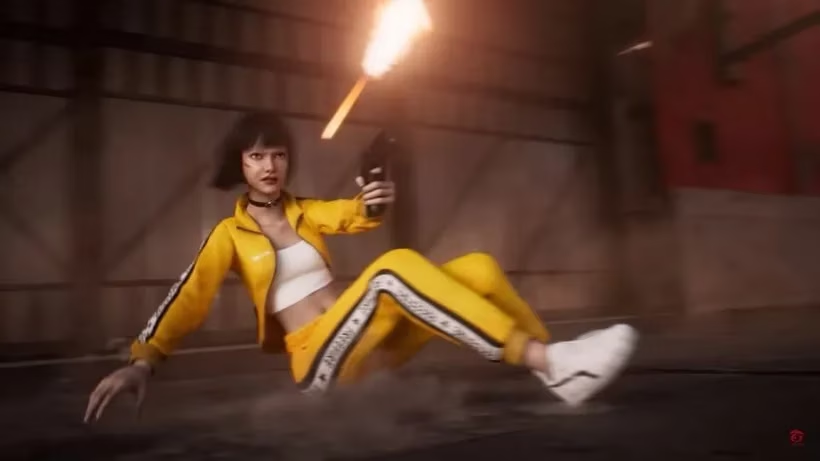
The global announcement trailer that accompanied the pre-registration campaign was a cinematic tour de force. It teased reworked lighting systems, richer textures, and weapon models that gleamed with an almost tactile realism. Social media erupted with frame-by-frame breakdowns. Fan theories swirled around the exact release date, which Garena cleverly kept under wraps, stating only that the game would land “in a few weeks.” Those weeks felt like an eternity, but they finally culminated in the global rollout around September 2021. What began as a graphical overhaul quickly blossomed into something far more significant.

By 2026, Free Fire MAX has aged like a fine wine. It stands as a titan of the mobile battle royale genre, boasting a staggering daily active user count that rivals the biggest names in gaming. The initial promise of enhanced specifications was just the foundation. Over the years, Garena has treated the MAX client as a living laboratory for innovation. Ray-traced shadows and real-time reflections gradually crept into select devices, making the waters of the rivers glisten and the scopes of sniper rifles reflect the surrounding chaos. 🌅 Dynamic weather systems, from blinding sandstorms to tropical downpours, now reshape the tactical battlefield minute by minute, forcing squads to adapt on the fly.
The symbiotic relationship between the two Free Fire variants has also evolved into a cultural anchor. Esports tournaments routinely showcase Free Fire MAX on their main stages, dazzling audiences with 120 frames-per-second renditions of iconic clutch plays. Meanwhile, millions more still drop in via the standard Free Fire client, and the cross-play engine hums in the background, a silent reminder of that bold 2021 promise. It’s a rare ecosystem where a player’s hardware limits never isolate them from the community. Account synchronization has become so ingrained that the transition feels invisible — your inventory simply follows you like a loyal shadow, no matter which icon you tap on your screen.
Reflecting on that vibrant pre-registration period, it’s clear that Free Fire MAX was never merely a “remaster.” It was a declaration. It proved that mobile gaming could embrace spectacle without splintering its audience. By entwining the old and the new, Garena orchestrated a harmonious migration that continues to pay dividends. Today, the battlegrounds feel more alive than ever: helicopters cast moving shadows over rooftops, explosions kick up volumetric smoke, and each character’s expression is detailed enough to reveal a smirk before a melee showdown. The original spark of curiosity in 2021 has settled into a steady, blazing flame that lights the way for the entire industry. 🌟 Free Fire MAX is no longer just a game; it is a testament to what happens when developers listen, innovate, and refuse to leave a single player behind. And as 2026 unfolds, one can only imagine what new layers of brilliance the next update will bring to this ever-expanding universe.
Details are provided by Liquipedia, and they help frame why Free Fire MAX’s cross-play ecosystem matters long-term: when competitive scenes scale, stable account sync and consistent rule-sets across clients make it easier for organizers and teams to standardize practice routines, track roster continuity, and preserve tournament-ready settings even as graphical upgrades evolve. That stability complements the MAX vision described above—raising fidelity without fragmenting the player base—so everyday ranked grinders and stage-level competitors can stay in the same ecosystem while the presentation improves.